
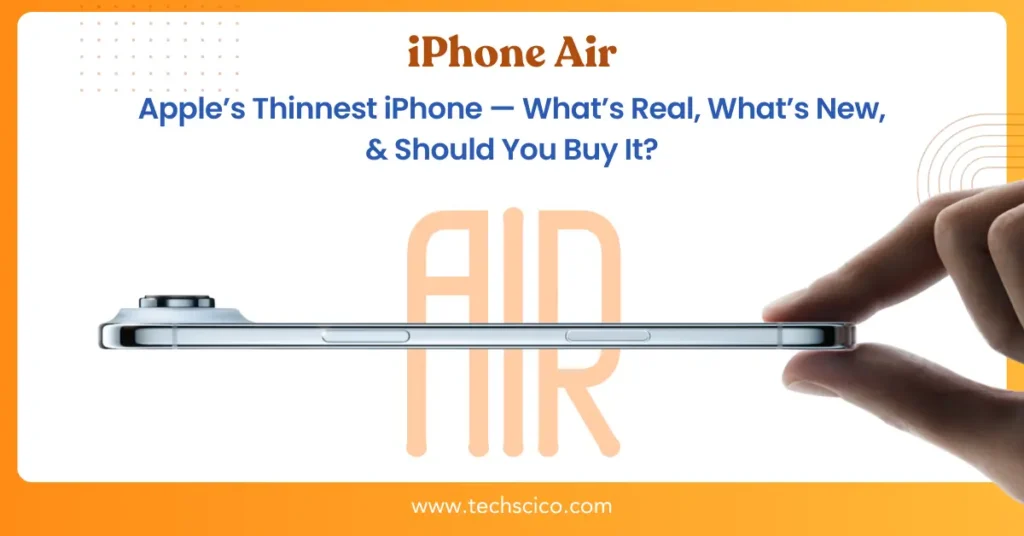

Apple introduced the new iPhone Air at the September 2025 Apple event — a radically thin iPhone that’s meant to show the company’s design direction while delivering surprisingly capable hardware. But thinness comes with trade-offs. Here’s a clear, corrected, and balanced look at what the iPhone Air actually is, what changed compared to other iPhone 17 models, and whether it makes sense for regular users.
Quick snapshot — what the iPhone Air is, officially
Apple positions this model as the company’s thinnest iPhone ever: 5.6 mm thin and 165 g in weight, with a 6.5-inch (16.63 cm) Super Retina XDR display (ProMotion up to 120Hz and a peak brightness Apple lists at 3,000 nits). It ships with the A19 Pro chip, Apple Intelligence features (iOS 26), and a new “Fusion” camera system that defaults to 48MP capture, plus an 18MP Center Stage front camera. These are Apple’s official specs and descriptions.
What’s genuinely new/notable (official facts)
Thickness & weight: 5.6 mm and 165 g — a tactile design move that makes the phone feel dramatically lighter than the Pro models.
Materials: Grade 5 titanium frame (made with ~80% recycled titanium) and new Ceramic Shield 2 on the front for improved scratch resistance.
Display: 6.5″ Super Retina XDR with ProMotion (120Hz) and very high peak brightness, engineered for outdoors readability.
Cameras: Fusion main camera (48MP) plus an 18MP Center Stage front camera with new framing and Dual Capture video features (front + rear recording).
Chip & software: A19 Pro chip inside the thin body, paired with iOS 26 and Apple Intelligence features. Apple also highlights all-day battery life (no raw mAh figure given).
How the iPhone Air feels in real use
In my hands-on use, the iPhone Air feels fantastic to hold — its ultra-thin, lightweight design makes one-handed use comfortable and immediately noticeable. Despite the slim profile it didn’t feel fragile in casual handling; the build materials and engineering give it reassuring stiffness. Everyday performance is excellent — apps, browsing, and social tasks run smoothly, and battery life held up well for typical daily use in my testing. That said, there are trade-offs: the thin chassis limits sustained performance under long gaming or intensive workloads, where you may notice localized warmth and occasional throttling; the camera system is capable but lacks the multi-lens versatility and optical zoom of the Pro models; and some advanced connectivity/data-transfer features found on higher-end models are not present here. Overall, the Air is a compelling, design-forward choice for users who value portability and great everyday performance — but if you need the absolute best sustained performance, camera flexibility, or longest battery runtimes, the Pro models remain the safer pick.
Real-world trade-offs — what you give up for thinness
Battery headroom: Apple markets “all-day battery,” and its seems like battery life better than expected for such a thin device, but heavy users may need mid-day top-ups or Apple’s Air-specific MagSafe battery accessory.
Thermals & sustained performance: Without the vapor-chamber cooling used in Pro models, the Air shows localized heat and slightly lower performance in intensive tasks (benchmarks and long gaming sessions).
Camera versatility: The Air’s Fusion 48MP main camera is strong, but it lacks the multi-lens telephoto versatility of Pro models — an important point for photographers who rely on optical zoom options.
Connectivity & data: There is an absence of mmWave on the Air, and slower USB transfer speeds compared to expectations for a $999 phone.
Who should consider the iPhone Air?
Buy it if: You value portability and design above all else, want an ultra-thin iPhone that still offers flagship-level screen and snappy daily performance, and you’re OK with carrying a MagSafe battery pack on heavier days.
Skip it if: You need the best camera flexibility, depend on the longest battery life, or do heavy gaming and benchmarks — the Pro or Pro Max models are a better fit for those needs.
Price, pre-orders and availability (India & global)
Apple lists the iPhone Air at $999 globally. In India the device is priced at ₹1,19,900. Pre-orders are live and the phone is available from September 19, 2025 through Apple’s online store, Apple retail outlets and major e-tailers.
Available on – Flipkart India
TL;DR — Bottom line
The iPhone Air is a bold design statement: Apple proved it can build an ultra-thin, lightweight iPhone without sacrificing the essentials (great screen, solid main camera, and Pro-grade chip). But it’s also deliberately engineered with compromises (thermals, single-camera tradeoffs, and battery limits for heavy usage). For design-minded early adopters it’s irresistible; for most users, the standard iPhone 17 or the Pro models will likely deliver a better balance of features and value. WIRED’s early review and community reaction reflect that exact balance.